

Summer Spiti vs Winter Spiti: Which Spiti Valley Trip Should You Take?
By Shivani Raghuvanshi, Co-Founder, Tour to Dreams
I’ve been around enough mountain travellers to know that when someone says, “I want to do Spiti,” my next question is always, “Summer or winter?” Because these aren’t just two different seasons in the same valley. They almost feel like two different Spitis. Summer Spiti is about open roads, long drives, green patches appearing between the mountains, villages coming alive and being able to explore without constantly worrying about the weather.
Winter Spiti is something else entirely.
It’s colder, quieter, harder and much more raw. The valley gets covered in snow, roads can become unpredictable and suddenly the same places you’ve seen in summer look completely different. I’ve travelled through the mountains enough to know that there isn’t really a better season.
It depends on what kind of traveller you are.
Summer Spiti: The One I’d Recommend First
If you’re travelling to Spiti for the first time, I would personally choose summer. There is something incredibly beautiful about entering Spiti when the roads are open, the little villages are active and you can actually stop wherever you want without constantly worrying about the weather.
The usual summer road trip through Himachal can take you from Shimla or Manali towards Kaza, depending on the route and road conditions. And the journey itself becomes one of the biggest memories of the trip.
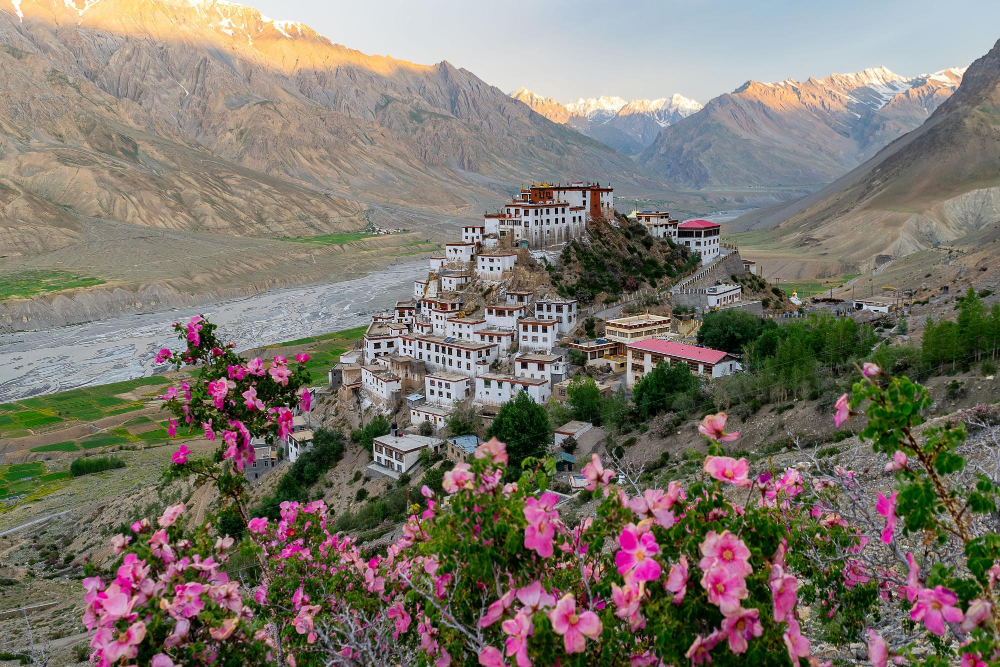
I still think that’s what people sometimes miss about Spiti. They focus so much on reaching Kaza that they forget how incredible the road is. You leave the greener landscapes of Kinnaur behind and slowly enter the dry, dramatic mountains of Spiti.
Summer spiti is better experienced on a Bike.
🏔️ Chandratal: The Summer Highlight
And then there is Chandratal. If you ask me about one place that makes a summer Spiti road trip feel extra special, this is it.
Chandratal, or the Moon Lake, sits at an altitude of around 4,300 metres in the Lahaul region. Getting there is an adventure in itself, with the landscape becoming more rugged and remote as you drive towards the lake. The first time you see pictures of Chandratal, it almost doesn’t look real.
A bright blue lake surrounded by enormous mountains, with absolutely nothing around it that makes you feel like you’re anywhere near a city. But pictures honestly don’t do it justice.
There’s something about walking towards the lake after spending hours on those mountain roads. You’re tired, your face is probably covered in dust, you’ve stopped for chai somewhere along the way and then suddenly you see this incredible blue lake sitting quietly between the mountains.
And that’s one of the reasons I love summer Spiti.
Chandratal is generally accessible only during the warmer months when the road conditions allow. Heavy winter snow makes access difficult or impossible for normal tourist road trips, which means if Chandratal is on your Spiti bucket list, you need to plan around the summer season and current road opening.
For me, a summer Spiti trip without Chandratal feels slightly incomplete.
And Then There’s Winter Spiti
Winter Spiti is a completely different story. The first time you see pictures of Spiti covered in snow, it’s easy to think, “This looks magical. I want to go.” And yes, it is magical. But it’s also difficult. Really difficult.
Winter strips away a lot of the comfort that you normally associate with travelling. Temperatures can fall far below freezing, roads can become icy or inaccessible, many tourist facilities operate differently or close for the season, and weather can completely change your plans. But that’s also what makes winter Spiti so special. The crowds disappear. The mountains become white. The roads become quieter and the valley suddenly feels incredibly isolated.
You’re not seeing the Spiti that appears in most travel reels. You’re seeing a side of the valley where people actually live through some of the harshest winters in the country.
Why Would I Go to Spiti in Winter? Honestly? For the feeling. Imagine waking up in a small homestay and looking outside the window to see everything covered in snow. You sit with a hot cup of chai, wrapped in layers, while there’s almost complete silence outside. There aren’t hundreds of tourists around. There isn’t traffic. There isn’t the usual rush to reach the next attraction. It’s just you, the mountains and the people who call this place home.
That kind of travel stays with you. And places like Kibber, Komic and Hikkim look completely different when winter arrives, although access can depend heavily on current weather and road conditions.
But I wouldn’t recommend winter Spiti to someone simply because they want “snow pictures.” You need to actually enjoy difficult travel because when something goes wrong in winter, you can’t just assume there will be another vehicle five minutes later.
So, Which Spiti Is Yours?
For me, the easiest way to explain it is this – Summer Spiti is the Spiti you travel through. Winter Spiti is the Spiti you live in, even if only for a few days.
Summer gives you movement. You wake up every morning wondering what the next road will look like. You chase sunsets, stop at villages, drive through mountain passes and, if the route is open, make your way to Chandratal.
Winter gives you stillness. You wake up and realise that sometimes the best thing you can do is sit quietly with a cup of chai and look outside and maybe that’s why I don’t think there is a winner between the two. They simply give you different versions of the same incredible place.
If you’re going with your friends for your first big Himalayan road trip, I’d pick summer without thinking twice. Give me the mountains, a long winding road, my friends, some terrible network, roadside Maggi and a night under the stars and if Chandratal is waiting at the end of that road? Even better.
But if you’re the kind of traveller who hears “extreme cold, difficult roads and unpredictable weather” and thinks “sounds interesting”..Well, maybe winter Spiti is waiting for you.
And trust me, when you eventually come back, you’ll have a lot more than photographs, You’ll have stories and that’s what I personally travel for.
Shivani Raghuvanshi
Co-Founder, Tour to Dreams